
Smart Battery Management System: How an Intelligent BMS Makes Batteries Safer and Smarter
2026-04-01
Batteries are no longer just components hidden inside vehicles or energy storage racks; they are becoming software-defined assets that can learn, predict, and optimize their own behavior. An AI-based battery management system (AI-BMS) is at the heart of this shift, combining sensors, cloud connectivity, and machine learning to unlock safer, smarter, and more profitable battery operations for mobility and energy players worldwide.
An AI-based battery management system builds on the foundation of a smart BMS—cell monitoring, protection, balancing, and communication—and adds advanced analytics and predictive intelligence. Instead of relying only on static rules, AI-BMS continuously learns from real-world data to improve how batteries are charged, discharged, routed, and maintained.
In practice, an AI-BMS typically offers:
More accurate estimates of State of Charge (SoC) and State of Health (SoH) over the battery's lifetime
Early detection of anomalies such as internal short circuits, abnormal self-discharge, and overheating tendencies
Adaptive control strategies that optimize performance and lifespan based on environment, usage patterns, and business priorities
This makes AI-BMS particularly valuable for high-utilization batteries in electric mobility, commercial fleets, battery swapping networks, and stationary energy storage projects, where uptime and lifecycle economics matter as much as the hardware itself.
An AI-based BMS links battery packs at the edge with powerful models in the cloud, forming a feedback loop that converts raw data into actionable intelligence. The system continuously cycles through four key stages.
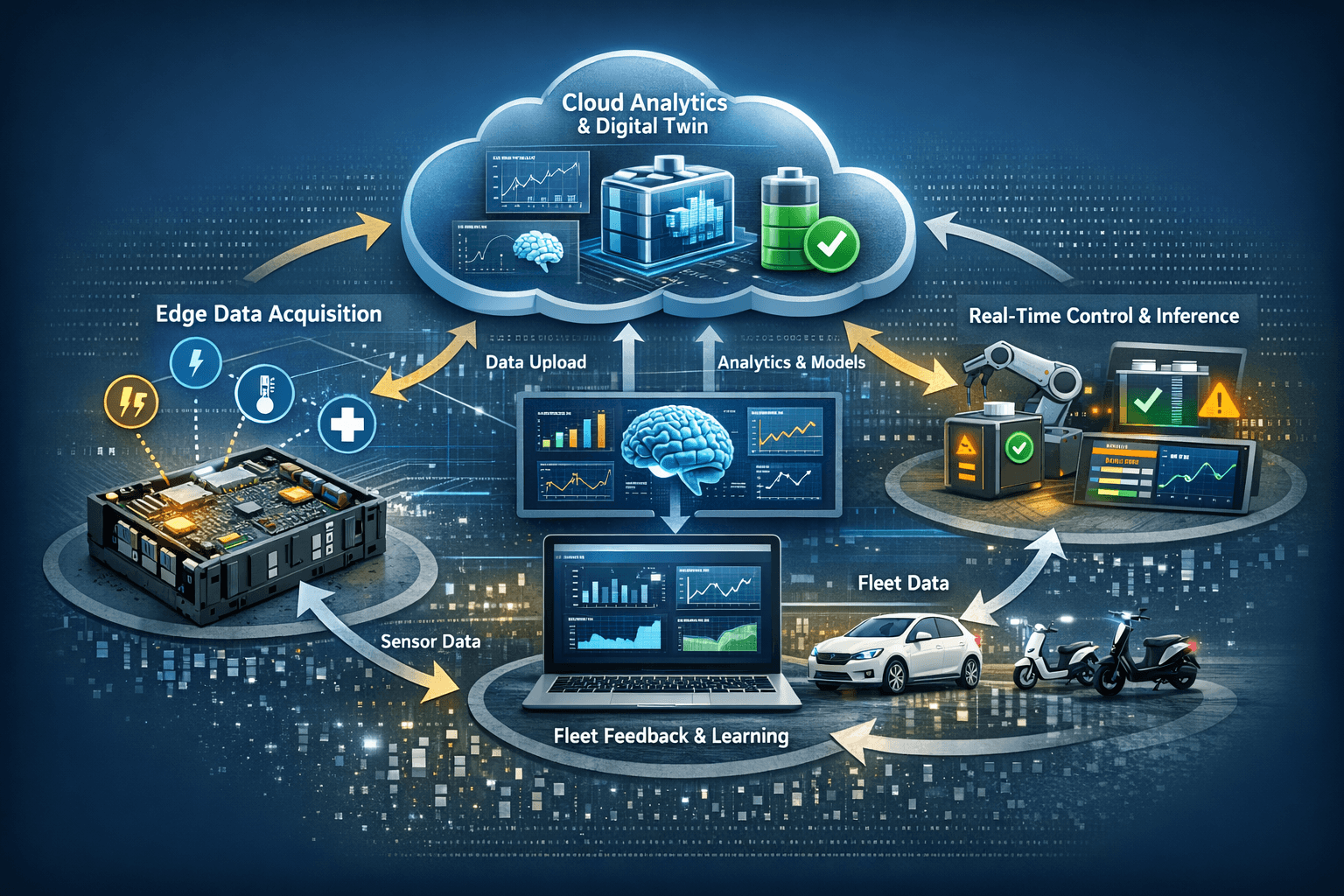
Each pack is equipped with sensors and an embedded controller that collect high-frequency measurements.
Typical data streams include:
Cell and pack voltages, charging and discharging currents
Multiple temperature points across cells and modules
Cycle count, charge rate history, depth-of-discharge patterns
Real-world load profiles and ambient environmental conditions
This telemetry is stored locally for real-time protection and periodically uploaded to the cloud, often via gateways or connected cabinets in shared infrastructures.
In the cloud, data from thousands or millions of batteries is aggregated into a "battery data lake." AI models—ranging from anomaly detection to degradation and Remaining Useful Life (RUL) prediction—are trained on this historical dataset.
These models can then:
Identify subtle patterns that precede failures or rapid degradation
Distinguish between normal aging and abuse-driven damage
Simulate "what-if" scenarios for different charging, routing, or usage strategies
Effectively, each physical pack gains a virtual counterpart in the cloud, enabling more precise decision-making than pack-only electronics can deliver.
Once trained, AI models are deployed for real-time inference either on the pack controller, at the gateway, or in the cloud. Every new event—such as a fast charge session, an unusually high current spike, or a temperature excursion—is evaluated against these models.
Typical responses include:
Adjusting charge current or maximum allowable depth of discharge
Triggering alerts or derating for packs that exceed risk thresholds
Recommending maintenance, swapping, or route changes before failures
This closes the loop between data, intelligence, and control, transforming traditional rule-based systems into adaptive, self-optimizing platforms.
Because AI-BMS solutions aggregate data from many batteries, they improve with scale and time. New chemistries, climates, or usage patterns feed back into model retraining, and updated strategies are gradually rolled out across the fleet.
As a result:
Estimation accuracy for SoH and RUL increases
Predictive maintenance becomes more precise, reducing false alarms
Operators get clearer visibility into cost per cycle and total lifecycle value
This fleet-level learning is one of the biggest strategic advantages of AI-based battery management compared with isolated, pack-level systems.
Industry experience increasingly shows that AI-driven battery management is no longer optional for serious electric mobility and energy businesses, because it directly impacts safety, cost, uptime, and sustainability.
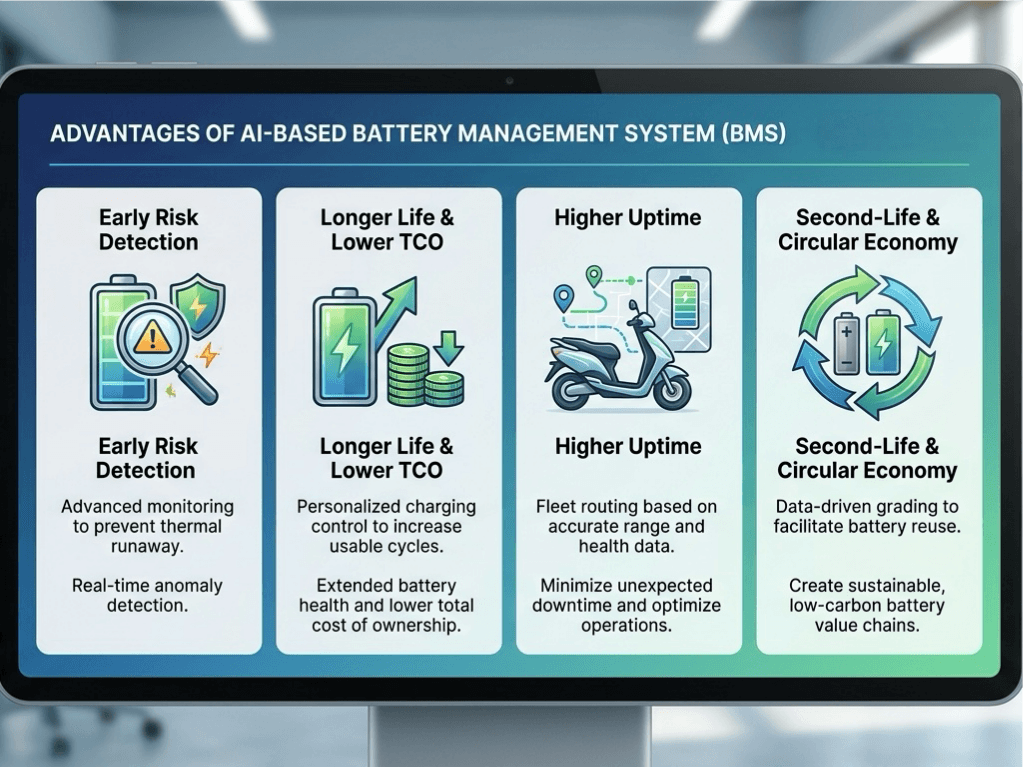
Thermal runaway and internal short circuits remain among the most critical risks in lithium-ion systems. AI-BMS can detect warning signals earlier than fixed-rule systems, including micro-level temperature patterns, unusual impedance changes, or abnormal voltage recovery after rest.
This enables:
Early isolation of high-risk packs, often tens of minutes or more before traditional alarms would trigger
Fewer emergency shutdowns and field incidents, improving user trust and compliance
Rich data for incident analysis and future design improvements
Some analyses estimate that AI-powered predictive maintenance can cut battery failure rates by 30–50%, significantly improving reliability for EV and storage projects.
Every extra usable cycle gained from a pack directly reduces cost per kilometer or per kWh delivered. AI-BMS extends life by adapting charge and discharge strategies to the actual condition of the battery rather than assuming a "one-size-fits-all" profile.
Benefits include:
Avoiding aggressive charging when packs are cold or already stressed
Optimizing depth of discharge to balance utilization with longevity
Tailoring usage intensity across a fleet so that no small subset of packs is overworked
Studies suggest that AI-driven battery management can improve usable lifespan by 10–40%, depending on application and existing practices—translating into fewer replacements, lower capex, and significantly reduced environmental impact.
In commercial use cases like delivery fleets, car- or scooter-sharing, and industrial equipment, battery downtime often means lost revenue. AI-BMS supports high availability by combining accurate range prediction, early fault detection, and fleet-level routing recommendations.
For operators, this can mean:
More confident utilization of available capacity without range anxiety
Fewer unexpected breakdowns in the middle of a shift or route
Smarter scheduling of maintenance that fits around peak hours and business commitments
When connected to dispatch systems and swap or charging infrastructure, AI-BMS becomes a core part of the operational "brain" for the entire fleet, not just the packs themselves.
As fleets and storage systems scale, second-life applications for batteries are becoming increasingly important. AI-BMS provides the rich, lifecycle-long data needed to decide which packs can safely be reused in lower-stress environments.
It supports:
Precise RUL estimation and grading for retired EV or mobility batteries
Matching of packs with similar health profiles into second-life storage blocks
Reliable documentation for regulators, insurers, and sustainability reporting
This data-driven approach is vital for building trusted circular battery ecosystems with predictable performance and risk profiles.
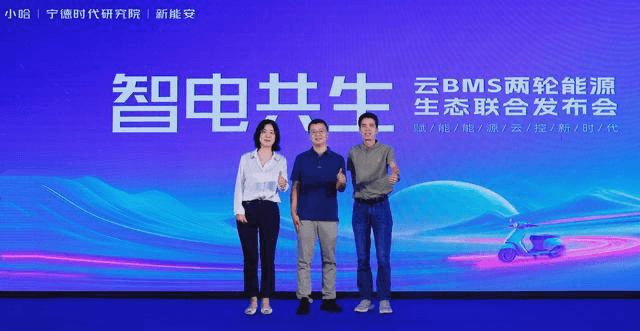
Launched on 4 July 2025 in Shanghai together with CATL's Future Energy Institute and Xin Neng An, Prism·Cloud BMS is HelloPower's AI-based battery management platform for high-frequency two-wheeler energy networks. By combining cloud intelligence, AI algorithms, and advanced manufacturing, it upgrades full-lifecycle health management, safety risk warning, range prediction, and SaaS capabilities in one system.
Rather than being just another regular smart BMS, Prism·Cloud BMS is built around fleet-scale data and closed-loop decision-making. Its key differentiators include:
High-precision risk models: Thermal runaway risk identification with about 90% accuracy and up to 30 minutes' early warning, plus a 16-category fault library covering temperature anomalies, cell inconsistency, voltage fluctuation, and self-discharge.
Lifecycle health optimization: AI health modeling, strategy-based dispatch, and balancing algorithms that extend average battery life by more than 10% and reduce unnecessary swaps or returns.
Rich "virtual profile" for every pack: Real-time collection and cloud streaming of charge/discharge data, SoH/SoC, temperature, resistance, and current to create a detailed digital profile that supports life prediction, abuse recognition, and active balancing.
Together, these features move daily operation from "protect when something goes wrong" to "predict and intervene before issues impact users."
Prism·Cloud BMS is evolving into an open SaaS layer that different stakeholders can plug into:
For end users, HelloPower plans "cloud battery" light apps so riders can check health, charge level, voltage, and usage tips directly on their phones, increasing transparency and trust in shared energy.
For business partners, the platform offers status dashboards, asset traceability, maintenance reminders, and historical analytics, with APIs to connect into fleet, warehouse, and billing systems.
For second-life and recycling partners, it provides RUL judgment and precise grading of retired packs to support efficient second-life use and higher residual value.
This SaaS approach makes Prism·Cloud BMS an infrastructure layer that can support cooperation with fleets, logistics platforms, city programs, and energy developers.
Prism·Cloud BMS is already widely deployed across HelloPower's extensive battery swapping network across 500+ cities, forming one of the world's leading sample pools for connected two-wheeler batteries. Reported operational results show clear gains:
Around 30% improvement in range stability and a 65% reduction in rider delays caused by battery faults.
A 91.32% increase in proactive maintenance, cutting roughly 3,600 km of fault-related losses per battery each year.
Approximately 40% lifecycle carbon reduction, with each battery contributing about 120 kg of carbon savings.
For riders, this means safer, more predictable energy every day; for partners, it demonstrates that AI-based battery management can scale from concept to city-level infrastructure.
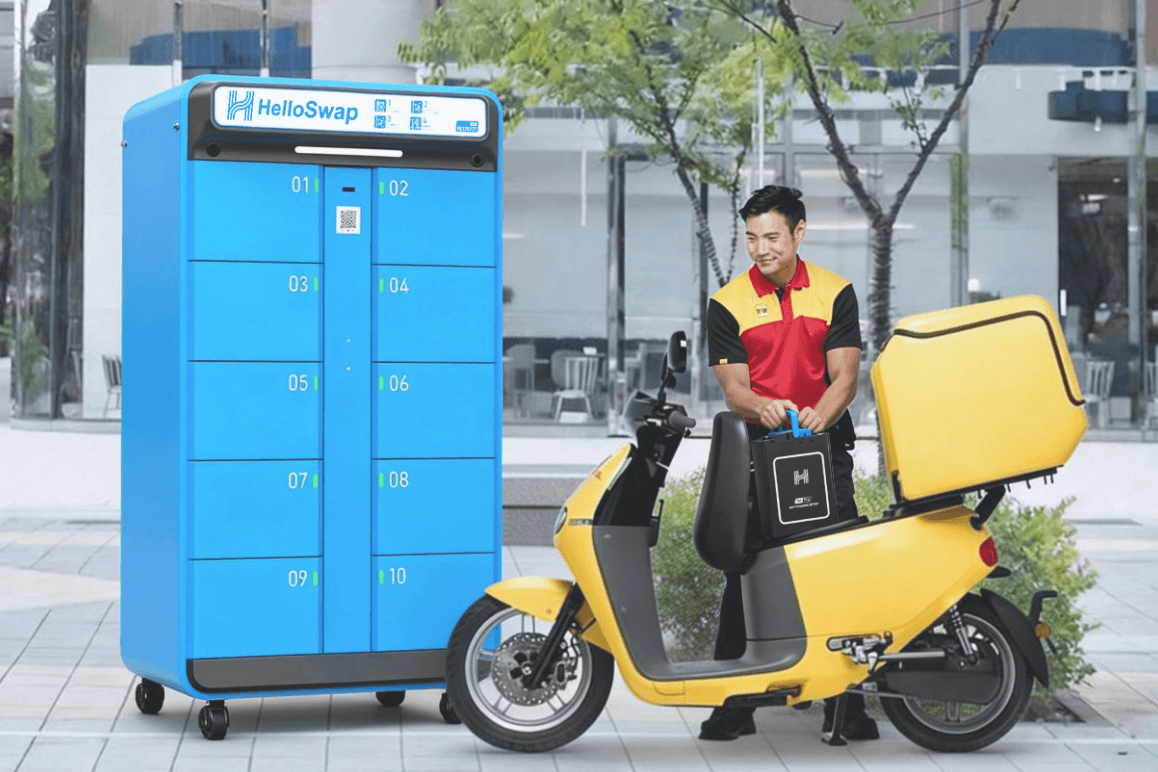
Building a competitive two-wheeler battery swapping network—from cabinet and pack design to cloud, algorithms, and daily operations—requires significant time and expertise. HelloPower (branded as HelloSwap in Thailand) offers a shortcut by combining AI-ready batteries and swapping cabinets with Prism·Cloud BMS and large-scale operating experience across more than 500 cities.
HelloPower can support partners by:
Supplying batteries and swapping cabinets co-designed with leading cell partners such as CATL, ready for AI-driven lifecycle management.
Deploying Prism·Cloud BMS as the safety, health, and range-intelligence backbone of public or semi-public battery swapping networks.
Integrating AI-BMS insights with dispatch platforms, rider apps, billing systems, and energy management tools through open APIs.
Contact Us
hellopowerglobal@hellobike.com
Location
2F, Building 1, No.898 XiuWen Road, MinHang District, Shanghai, China
Copyright © 2024 福建宁德惠智无限科技有限公司 All Rights Reserved. 闽ICP备2023025900号-3.


