
Battery Swapping Cabinet Safety Standards Explained: Fire Protection, BMS, and Compliance
2026-01-23
Electric vehicles have moved from pilot programs into mainstream adoption in many cities around the world. Yet one friction point continues to slow adoption at scale: the battery — the most expensive component in any EV—whether it's a two-wheeler, three-wheeler, passenger vehicle, or commercial vehicle—the slowest to replenish, and a primary driver behind range anxiety concerns. Battery as a Service, or BaaS, is the business model built specifically to resolve this friction—and understanding how it works reveals why it's becoming one of the most consequential frameworks in the global EV transition.
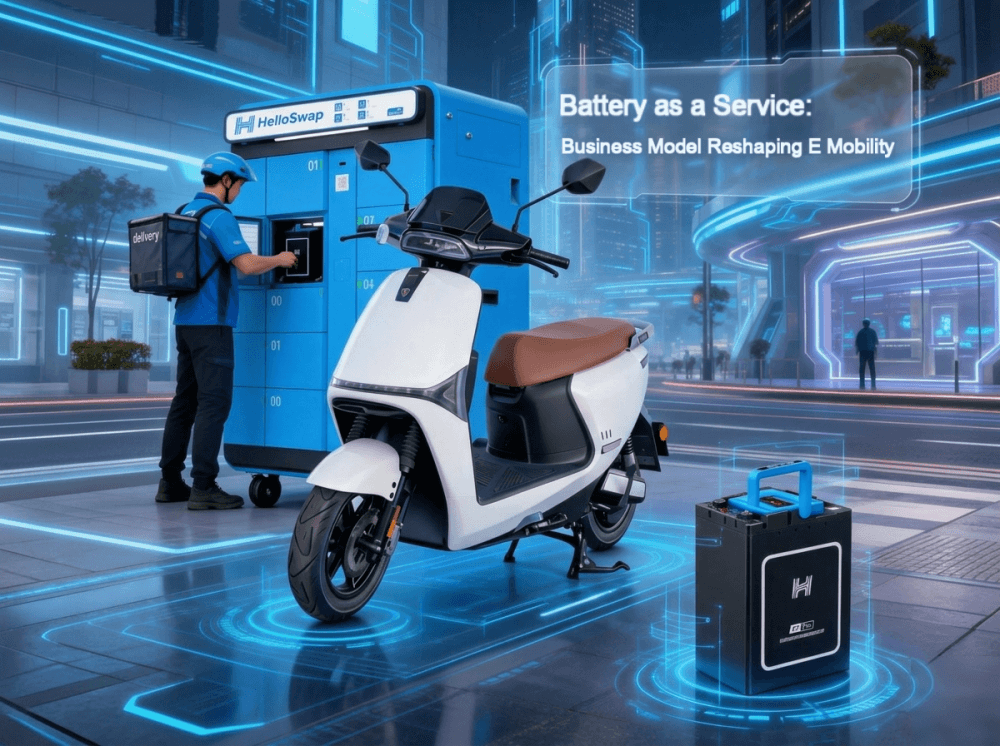
Battery as a Service (BaaS) is a model that decouples battery ownership from vehicle ownership. Instead of buying an EV with a battery included, the rider or driver purchases (or rents) the vehicle alone, and then subscribes to a network that provides battery access on demand. The battery is never "owned" by the user; it's a managed asset leased and maintained by the service provider.
The financial logic is straightforward. Batteries have historically accounted for up to 30–40% of an EV's purchase price. Strip that cost out of the purchase, and EV adoption becomes far more accessible, lowering the barrier to entry for individual riders, fleet operators, and mobility businesses across every market.
The "as a service" framing is intentional. Just as Software-as-a-Service shifted enterprise IT from capital expenditure to operational expenditure, BaaS shifts one of the largest cost barriers in EV ownership into a manageable, predictable monthly or per-use fee.
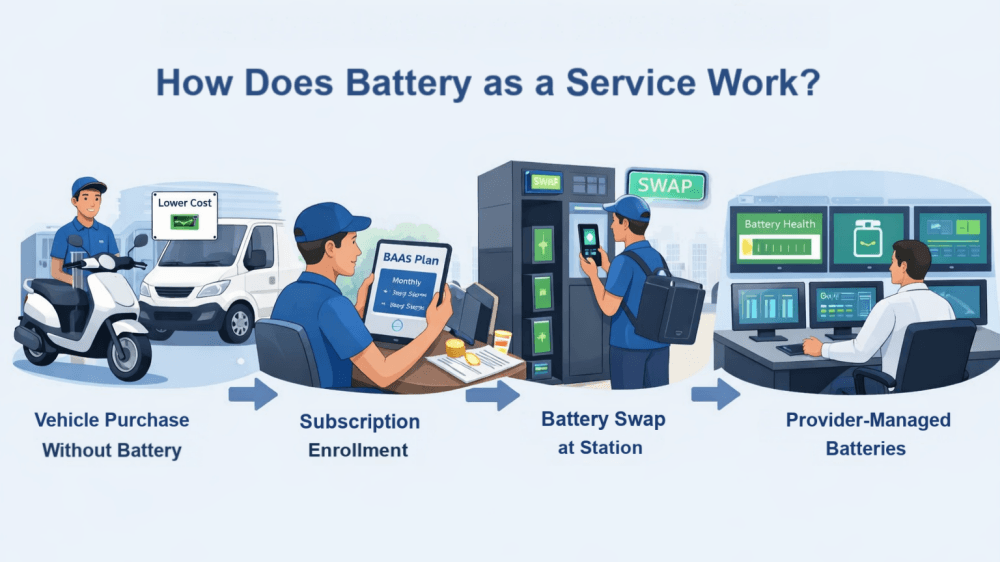
The mechanics of BaaS vary by vehicle segment and market, but the core loop is consistent:
Vehicle purchase without battery: The customer acquires an electric two-wheeler, taxi, or delivery vehicle at a reduced price because the battery pack is excluded from the sale.
Subscription enrollment: The user signs up for a BaaS plan, paying either a flat monthly fee for unlimited swaps or a pay-per-swap rate for occasional use.
Battery swap at a station: When the battery runs low, the user locates a nearby swapping cabinet via a mobile app, initiates the swap with a QR code scan in seconds, and completes the full physical exchange in under a minute—walking away with a fully charged battery.
Provider-managed battery lifecycle: The service provider owns, charges, monitors, and maintains every battery in the network. Users are never responsible for degradation, warranty claims, or replacement costs.
For delivery riders and fleet operators—the highest-utilization users—this model is transformative. A food delivery rider who once had to wait 4–8 hours for a two-wheeler to charge can now swap and be back on the road in under a minute, with no interruption to earnings.
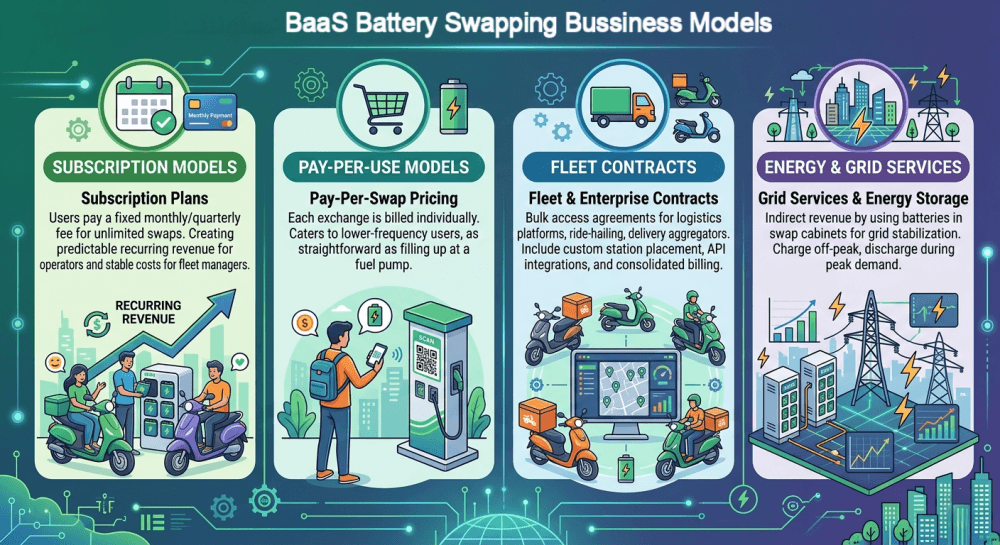
Market estimates indicate strong growth in the BaaS sector. For example, DataM Intelligence reports the market reached approximately USD 1.71 billion in 2024, with projected annual growth of over 25%. This growth is supported by several distinct monetization structures:
Subscription plans are the backbone of most BaaS operations. Users pay a fixed monthly or quarterly fee for unlimited swaps, creating predictable recurring revenue for operators and stable, forecastable costs for fleet managers who need to budget transport expenses accurately.
Pay-per-swap pricing caters to lower-frequency users or markets where subscription adoption is still building. Each exchange is billed individually—as straightforward as filling up at a fuel pump.
Fleet and enterprise contracts represent the highest-value segment. Logistics platforms, ride-hailing companies, and delivery aggregators negotiate bulk access agreements that include custom station placement, API integrations with their dispatch systems, and consolidated billing across an entire fleet.
Beyond direct swap fees, BaaS providers unlock indirect revenue through grid services. Batteries sitting idle in swap cabinets can be charged during off-peak electricity hours and discharged during peak demand—potentially turning swap stations into distributed energy storage nodes, increasingly attractive to utilities and municipal energy planners.
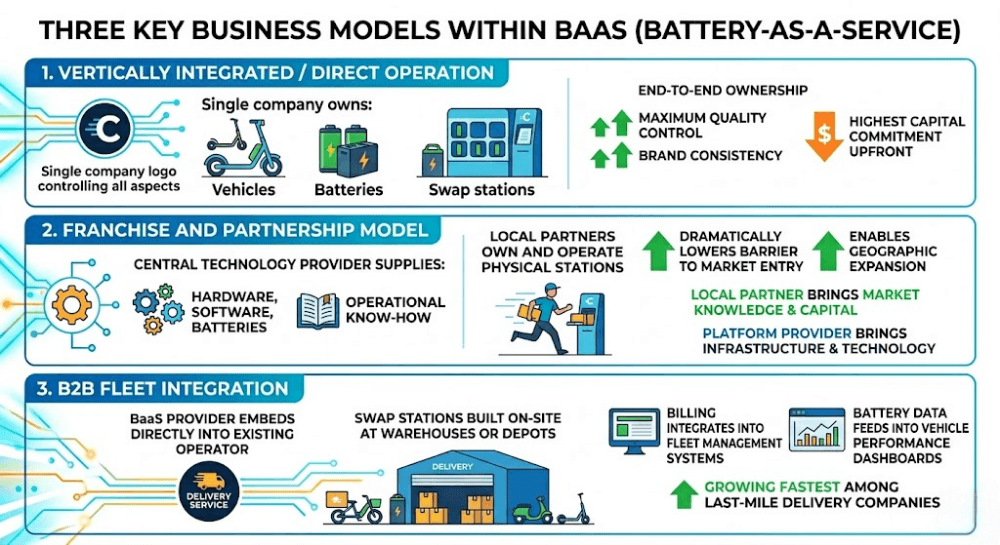
Not all BaaS deployments look the same. Three primary operating structures have emerged globally:
Vertically integrated / direct operation: A single company owns the vehicles, batteries, and swap stations end-to-end. This provides maximum quality control and brand consistency but requires the highest capital commitment upfront.
Franchise and partnership model: A central technology provider supplies hardware, software, batteries, and operational know-how, while local partners own and operate the physical stations. This dramatically lowers the barrier to market entry and enables geographic expansion without proportional capital scaling. The local partner brings market knowledge and capital; the platform provider brings proven infrastructure and technology.
B2B fleet integration: The BaaS provider embeds directly into an existing mobility or logistics operator. Swap stations are built on-site at warehouses or depots, billing integrates into fleet management systems, and battery data feeds into vehicle performance dashboards. This model is growing fastest among last-mile delivery companies seeking to eliminate fuel cost volatility.
The commercial case for BaaS rests on a convergence of benefits that traditional EV charging cannot replicate:
Lower entry cost: Removing the battery from the vehicle sticker price reduces the initial purchase barrier meaningfully, whether for an individual rider or a fleet operator procuring hundreds of units.
Zero charging downtime: A swap takes seconds to minutes, not hours—critical for any professional or commercial operation where vehicle uptime directly equals revenue.
Guaranteed battery performance: The provider maintains battery health across its entire network; users receive a certified, high-performing battery every time, with degradation managed entirely by the provider.
Safer charging infrastructure: Professionally managed cabinets with thermal monitoring and real-time fault detection eliminate the fire risks associated with informal or unregulated home charging.
Operational cost predictability: Subscription pricing converts variable fuel spend into a fixed line item, simplifying financial planning for riders and fleet managers at every scale.
BaaS is not without real structural challenges that any informed operator or investor should understand clearly.
Standardization remains the most persistent obstacle. For swap stations to serve multiple vehicle brands, battery packs need compatible form factors—something that requires either regulatory intervention or broad industry cooperation. Progress is most visible in China, where policy guidance has pushed manufacturers toward modular designs, and in Europe, where industry bodies have begun establishing formal interoperability standards. Global alignment is still a work in progress, but the long-term direction is increasingly clear.
Infrastructure capital requirements are substantial. Building a swap network with sufficient density to be genuinely convenient requires significant upfront investment. The station must be close enough that users don't find it easier to charge elsewhere—network density and network value are directly linked, which is why operators with established networks hold a compounding advantage over new entrants.
Educating users plays a larger role than many operators initially expect. People accustomed to fueling from a pump or charging overnight need to understand the ownership model shift—particularly regarding battery responsibility, performance guarantees, and what a subscription actually covers. These are solvable challenges, not fundamental flaws. Where BaaS has scaled successfully, adoption tends to accelerate sharply once network density reaches a critical threshold.
Understanding the BaaS model conceptually is one thing. Actually running it at scale—with real accountability, real hardware, and millions of real users—is another. That gap between understanding the model and deploying it reliably is precisely what HelloPower is built to close.
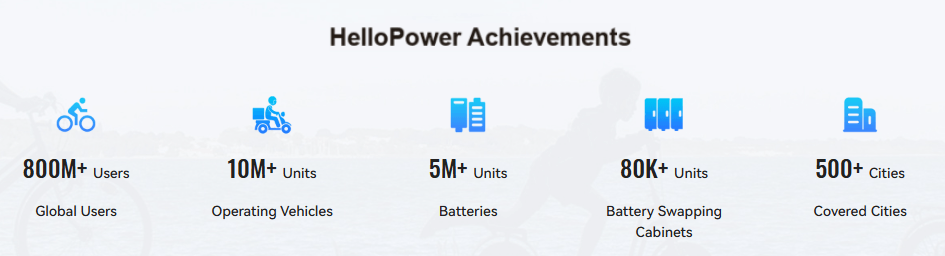
Co-founded by Hello Inc., Ant Group, and CATL, HelloPower (operating as HelloSwap in Thailand) combines significant operational scale, financial technology infrastructure, and world-class battery manufacturing into a single end-to-end platform that includes:
Hardware: Standardized swap cabinets (5–12 slots), multi-spec battery packs with LFP and NCM chemistry options, and compatible two-wheeler EVs engineered for commercial-intensity daily use.
Software: A four-layer digital platform covering the consumer swap app (6–15-second QR-code-based swap, multi-language, multi-currency support), a real-time operations dashboard tracking battery health and inventory across the network, an O&M mobile app for field teams, and a PaaS layer for deep fleet data integration.
Business model flexibility: Partners can choose joint operation with shared CAPEX, equipment leasing to convert heavy assets onto a lighter balance sheet, or connections to green energy and ESG investment funds for infrastructure financing.
Billing versatility: End users access pay-per-swap or monthly and quarterly unlimited subscription plans; fleet operators receive custom pricing tiers, usage reporting, and API connectivity to their own dispatch and order management systems.
Taken together, these capabilities position HelloPower as a fully integrated BaaS platform for partners entering or scaling in this space.
Battery as a Service is not simply a clever pricing structure. It's a fundamental rethinking of who should own, manage, and be accountable for the most critical infrastructure in the EV transition. When the battery becomes a managed service asset rather than a consumer product, it charges more intelligently, lasts longer, retires responsibly, and ultimately costs less for every operator and rider who depends on it.
This logic applies across every market where urban mobility is being electrified and commercial fleets are under pressure to cut costs, reduce emissions, and keep vehicles running. The opportunity is global—and the infrastructure, operational frameworks, and partnership models to capture it already exist.
If you're evaluating battery swapping business models, you can connect with HelloPower's team to further explore our cooperation models and determine the right approach for your market.
Contact Us
hellopowerglobal@hellobike.com
Location
2F, Building 1, No.898 XiuWen Road, MinHang District, Shanghai, China
Copyright © 2024 福建宁德惠智无限科技有限公司 All Rights Reserved. 闽ICP备2023025900号-3.


