
CATL Swappable Battery Technology for Electric Two-Wheelers: How HelloPower Turns It Into a Working Network
2026-03-27
A smart battery management system is the electronic "brain" that keeps modern lithium-ion batteries safe, efficient, and predictable. It turns a group of cells into an intelligent energy unit that can be monitored, controlled, and integrated into EVs, energy storage systems, and battery swapping networks.
A smart battery management system (smart BMS) is an embedded electronic system that measures, protects, and optimizes a rechargeable battery in real time. It continuously tracks voltage, current, temperature, State of Charge (SoC), and State of Health (SoH) to keep the battery within its safe operating ranges.
Unlike simple protection boards, an intelligent BMS may calculate State of Power (SoP), logs operating history, and communicates with external devices and cloud platforms over interfaces CAN, Bluetooth, cellular, or industrial links like RS-485. This makes it suitable for electric vehicles, stationary energy storage, telecom backup, industrial equipment, and shared mobility systems.

Many older or low-cost batteries rely on basic protection circuits designed mainly to disconnect the battery under extreme conditions such as overcharge, over-discharge, or short circuit. These systems may prevent immediate damage but provide limited information and no advanced control.
A smart battery management system adds several layers of capability:
Deeper sensing: Cell-level voltage and multi-point temperature rather than pack-level only.
State estimation: Algorithms for SoC, SoH, and often SoP to support more precise decisions.
Data logging: Event and trend records that support diagnostics and lifecycle management.
Connectivity: Interfaces to vehicles, inverters, chargers, swap cabinets, energy controllers, and cloud services.
These features are increasingly required in EV packs, residential and commercial ESS, telecom backup systems, and battery swapping networks where uptime and traceability are critical.
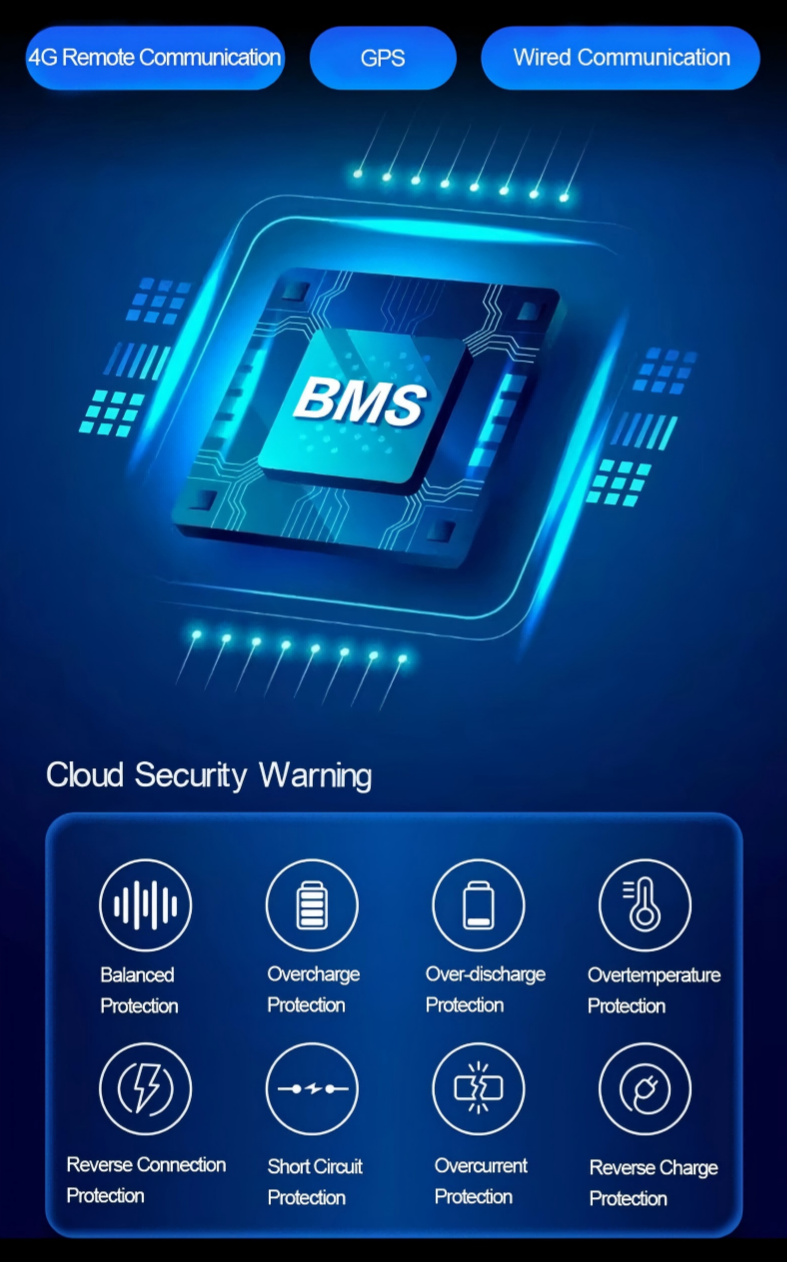
Inside any lithium-ion system, safe operation depends on keeping cells within their allowed voltage and temperature limits. A smart BMS supports this with real-time functions such as:
Measuring cell and pack voltage to avoid overcharge and deep discharge
Tracking charge and discharge current to understand loading and stress
Monitoring temperature sensors at strategic points in the pack
Calculating SoC to inform range or remaining runtime
Estimating SoH to indicate capacity fade and internal resistance changes
These capabilities are used in EV traction batteries, home solar storage, telecom backup packs, and mobile equipment to deliver predictable performance instead of guesswork.
A smart BMS enforces multi-level safety rather than relying on a single hard disconnect. Typical responses include:
Limiting charging current when cells approach upper temperature limits
Reducing discharge current when voltage or temperature move toward unsafe zones
Opening contactors or protection switches during short circuits or severe faults
This approach helps prevent thermal runaway—supported by both battery chemistry and firmware algorithms—extends useful life, and supports compliance in regulated applications such as grid-connected ESS and certified EV packs.
Cell imbalance is a major cause of early capacity loss in multi-cell packs. Smart BMS platforms address this using:
Passive balancing to bleed surplus charge from higher-voltage cells
Active balancing to redistribute energy more efficiently between cells
Balanced cells allow EVs to maintain range, ESS systems to use more of their installed capacity, and swapped batteries to deliver consistent performance over many cycles.
Because a smart BMS records operating history, it becomes a powerful diagnostic and planning tool. Operators can use BMS data to:
Detect abnormal temperature or voltage behavior before failures occur
Compare degradation patterns across sites, vehicles, or routes
Schedule inspections, replacements, or redeployments based on real conditions rather than fixed time intervals
In EV fleets, solar-plus-storage systems, and telecom sites, this supports predictive maintenance, reduces downtime, and improves total cost of ownership.
A key difference between a basic and a smart BMS is how the system communicates with its environment. Depending on the application, a smart BMS can:
Provide EV inverters or motor controllers with SoC, SoH, and power limits
Share data with home or commercial energy management systems in ESS installations
Report status to remote monitoring platforms in telecom backup or industrial setups
Coordinate with chargers and battery swap cabinets in shared mobility networks
These connections enable cloud dashboards, over-the-air updates, and data-driven energy and mobility services.
Battery swapping for electric two-wheelers is one of the most demanding use cases for smart BMS technology. Packs are shared between riders, used in different vehicles, and cycled frequently through swap cabinets across a city.
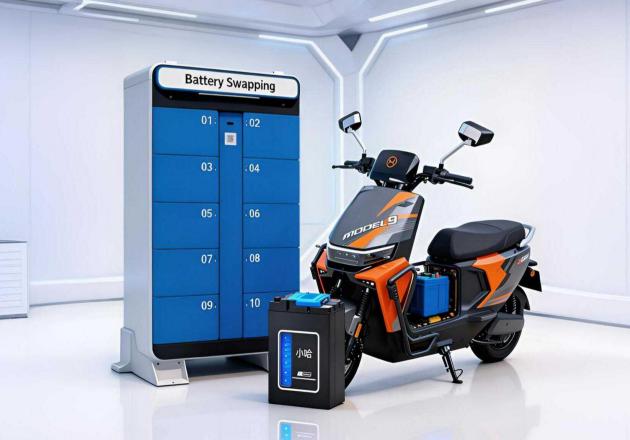
In this context, an intelligent battery management system is essential to:
Verify each battery's identity and health before charging or issuing it to a rider
Enable fast, automated swaps while keeping unsafe batteries out of circulation
Provide accurate SoC so riders receive consistent, predictable range per swap
Supply lifecycle data so operators can manage assets and costs with confidence
Two-wheeler battery swapping networks depend on these capabilities to keep fleets running with minimal downtime and controlled risk.
HelloPower (HelloSwap in Thailand), backed by Hello Inc., Ant Group, and CATL, focuses on end-to-end electric two-wheeler energy solutions built around purpose-designed swappable batteries, intelligent cabinets, and cloud coordination. Its systems combine CATL lithium-ion cell technology with intelligent BMS and city-scale operating experience across hundreds of urban markets.
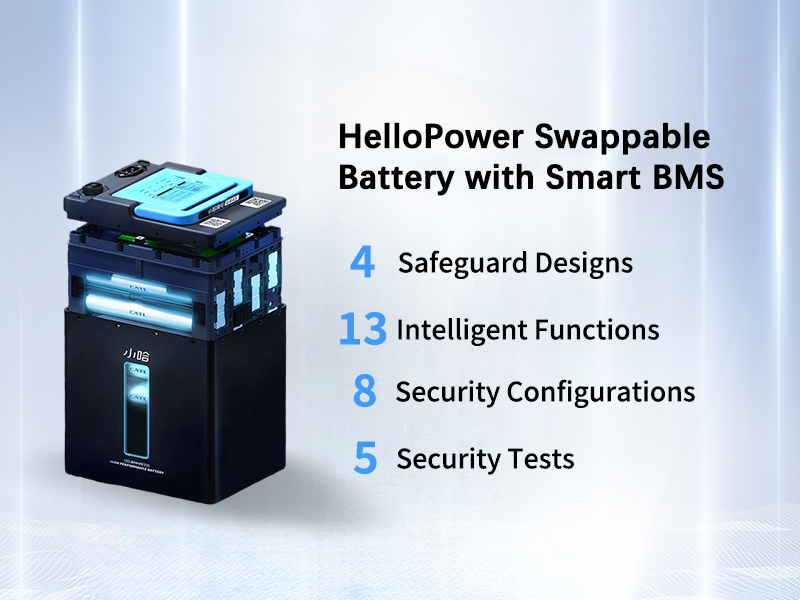
In HelloPower's ecosystem, the smart BMS embedded in each swappable battery is used to:
Monitor SoC and SoH in real time for large fleets of packs
Support 6–15 second automated swaps with cabinet-side health checks
Authenticate batteries and prevent unauthorized or unsafe units from entering the network
Connect via IoT modules such as 4G and positioning systems for tracking and analytics
Swap cabinets read BMS data the moment a battery is docked, confirm safety, and apply suitable charging profiles within the supported voltage and current ranges. Cloud software then orchestrates inventory and charging across the network, using BMS information to maintain availability and protect cycle life.
For fleets, platforms, and city partners, this combination of smart BMS, robust hardware, and data-driven operations offers a ready-made foundation to launch or scale profitable two-wheeler battery swapping services.
If you are planning or expanding an electric two-wheeler battery swapping network, contact HelloPower to explore how its smart BMS-based solution can support your riders and business.
Contact Us
hellopowerglobal@hellobike.com
Location
2F, Building 1, No.898 XiuWen Road, MinHang District, Shanghai, China
Copyright © 2024 福建宁德惠智无限科技有限公司 All Rights Reserved. 闽ICP备2023025900号-3.


